
Refactor high-complexity React components in Dify frontend. Use when `pnpm analyze-component...

npx skills add tripleyak/SkillForge
Or install specific skill: npx add-skill https://github.com/tripleyak/SkillForge
Intelligent skill router and creator. Analyzes ANY input to recommend existing skills, improve them, or create new ones. Uses deep iterative analysis with 11 thinking models, regression questioning, evolution lens, and multi-agent synthesis panel. Phase 0 triage ensures you never duplicate existing functionality.
name: skillforge
description: "Intelligent skill router and creator. Analyzes ANY input to recommend existing skills, improve them, or create new ones. Uses deep iterative analysis with 11 thinking models, regression questioning, evolution lens, and multi-agent synthesis panel. Phase 0 triage ensures you never duplicate existing functionality."
license: MIT
metadata:
version: 4.0.0
model: claude-opus-4-5-20251101
subagent_model: claude-opus-4-5-20251101
domains: [meta-skill, automation, skill-creation, orchestration, agentic, routing]
type: orchestrator
inputs: [any-input, user-goal, domain-hints]
outputs: [SKILL.md, references/, scripts/, SKILL_SPEC.md, recommendations]
Analyzes ANY input to find, improve, or create the right skill.
Any input works. SkillForge will intelligently route to the right action:
# These all work - SkillForge figures out what you need:

SkillForge: create a skill for automated code review
→ Creates new skill (after checking no duplicates exist)

help me debug this TypeError
→ Recommends ErrorExplainer skill (existing)

improve the testgen skill to handle React components better
→ Enters improvement mode for TestGen

do I have a skill for database migrations?
→ Recommends DBSchema, database-migration skills

TypeError: Cannot read property 'map' of undefined
→ Routes to debugging skills (error detected)
SkillForge: {goal} - Full autonomous skill creationcreate skill - Natural language activationdesign skill for {purpose} - Purpose-first creationultimate skill - Emphasize maximum qualityskillforge --plan-only - Generate specification without execution{any input} - Analyzes and routes automaticallydo I have a skill for - Searches existing skillswhich skill / what skill - Recommends matching skillsimprove {skill-name} skill - Enters improvement modehelp me with / I need to - Detects task and routes| Input | Output | Quality Gate |
|---|---|---|
| Any input | Triage → Route → Action | Phase 0 analysis |
| Explicit create | New skill | Unanimous panel approval |
| Task/question | Skill recommendation | Match confidence ≥60% |
ANY USER INPUT
(prompt, error, code, URL, question, task request)
    │
    ▼
┌─────────────────────────────────────────────────────┐
│ Phase 0: SKILL TRIAGE (NEW)                         │
│ • Classify input type (create/improve/question/task)│
│ • Scan 250+ skills in ecosystem                     │
│ • Match against existing skills with confidence %   │
│ • Route to: USE | IMPROVE | CREATE | COMPOSE        │
├─────────────────────────────────────────────────────┤
│         ↓ USE_EXISTING    ↓ IMPROVE      ↓ CREATE   │
│      [Recommend]      [Load & Enhance] [Continue]   │
└─────────────────────────────────────────────────────┘
    │ (if CREATE_NEW or IMPROVE_EXISTING)
    ▼
┌─────────────────────────────────────────────────────┐
│ Phase 1: DEEP ANALYSIS                              │
│ • Expand requirements (explicit, implicit, unknown) │
│ • Apply 11 thinking models + Automation Lens        │
│ • Question until no new insights (3 empty rounds)   │
│ • Identify automation/script opportunities          │
├─────────────────────────────────────────────────────┤
│ Phase 2: SPECIFICATION                              │
│ • Generate XML spec with all decisions + WHY        │
│ • Include scripts section (if applicable)           │
│ • Validate timelessness score ≥ 7                   │
├─────────────────────────────────────────────────────┤
│ Phase 3: GENERATION                                 │
│ • Write SKILL.md with fresh context                 │
│ • Generate references/, assets/, and scripts/       │
├─────────────────────────────────────────────────────┤
│ Phase 4: SYNTHESIS PANEL                            │
│ • 3-4 Opus agents review independently              │
│ • Script Agent added when scripts present           │
│ • All agents must approve (unanimous)               │
│ • If rejected → loop back with feedback             │
└─────────────────────────────────────────────────────┘
    │
    ▼
Production-Ready Agentic Skill
Key principles:
- Phase 0 prevents duplicates - Always checks existing skills first
- Evolution/timelessness is the core lens (score ≥ 7 required)
- Every decision includes WHY
- Zero tolerance for errors
- Autonomous execution at maximum depth
- Scripts enable self-verification and agentic operation
| Command | Action |
|---|---|
SkillForge: {goal} |
Full autonomous execution |
SkillForge --plan-only {goal} |
Generate specification only |
SkillForge --quick {goal} |
Reduced depth (not recommended) |
SkillForge --triage {input} |
Run Phase 0 triage only |
SkillForge --improve {skill} |
Enter improvement mode for existing skill |
Before creating anything, SkillForge intelligently analyzes your input to determine the best action.
┌────────────────────────────────────────────────────────────────────┐
│                        ANY USER INPUT                               │
│  (prompt, error, code, URL, question, task request, anything)      │
└────────────────────────────────────────────────────────────────────┘
                              │
                              ▼
┌────────────────────────────────────────────────────────────────────┐
│  Step 1: INPUT CLASSIFICATION                                       │
│  ┌─────────────────┐ ┌─────────────────┐ ┌─────────────────┐       │
│  │ explicit_create │ │ explicit_improve│ │ skill_question  │       │
│  │ "create skill"  │ │ "improve skill" │ │ "do I have..."  │       │
│  └─────────────────┘ └─────────────────┘ └─────────────────┘       │
│  ┌─────────────────┐ ┌─────────────────┐ ┌─────────────────┐       │
│  │  task_request   │ │  error_message  │ │  code_snippet   │       │
│  │ "help me with"  │ │ "TypeError..."  │ │ [pasted code]   │       │
│  └─────────────────┘ └─────────────────┘ └─────────────────┘       │
└────────────────────────────────────────────────────────────────────┘
                              │
                              ▼
┌────────────────────────────────────────────────────────────────────┐
│  Step 2: SKILL ECOSYSTEM SCAN                                       │
│  • Load index of 250+ skills (discover_skills.py)                  │
│  • Match input against all skills with confidence scoring          │
│  • Identify top matches with reasons                               │
└────────────────────────────────────────────────────────────────────┘
                              │
                              ▼
┌────────────────────────────────────────────────────────────────────┐
│  Step 3: DECISION MATRIX                                            │
│                                                                     │
│  Match ≥80%  + explicit create → CLARIFY (duplicate warning)       │
│  Match ≥80%  + other input     → USE_EXISTING (recommend skill)    │
│  Match 50-79%                  → IMPROVE_EXISTING (enhance match)  │
│  Match <50%  + explicit create → CREATE_NEW (proceed to Phase 1)   │
│  Multi-domain detected         → COMPOSE (suggest skill chain)     │
│  Ambiguous input               → CLARIFY (ask for more info)       │
└────────────────────────────────────────────────────────────────────┘
| Action | When | Result |
|---|---|---|
| USE_EXISTING | Match ≥80% | Recommends existing skill(s) to invoke |
| IMPROVE_EXISTING | Match 50-79% | Loads skill and enters enhancement mode |
| CREATE_NEW | Match <50% | Proceeds to Phase 1 (Deep Analysis) |
| COMPOSE | Multi-domain | Suggests skill chain via SkillComposer |
| CLARIFY | Ambiguous or duplicate | Asks user to clarify intent |
# Run triage on any input
python scripts/triage_skill_request.py "help me debug this error"

# JSON output for automation
python scripts/triage_skill_request.py "create a skill for payments" --json

# Examples:
python scripts/triage_skill_request.py "TypeError: Cannot read property 'map'"
# → USE_EXISTING: Recommends ErrorExplainer (92%)

python scripts/triage_skill_request.py "create a skill for code review"
# → CLARIFY: CodeReview skill exists (85%), create anyway?

python scripts/triage_skill_request.py "help me with API and auth and testing"
# → COMPOSE: Multi-domain, suggests APIDesign + AuthSystem + TestGen chain
Phase 0 uses a pre-built index of all skills:
# Rebuild skill index (run periodically or after installing new skills)
python scripts/discover_skills.py

# Index location: ~/.cache/skillrecommender/skill_index.json
# Scans: ~/.claude/skills/, plugins/marketplaces/*, plugins/cache/*
Before distribution, validate your skill:
# Quick validation (required for packaging)
python scripts/quick_validate.py ~/.claude/skills/my-skill/

# Full structural validation
python scripts/validate-skill.py ~/.claude/skills/my-skill/

# Package for distribution
python scripts/package_skill.py ~/.claude/skills/my-skill/ ./dist
Skills must use only these allowed frontmatter properties:
| Property | Required | Description |
|---|---|---|
name |
Yes | Hyphen-case, max 64 chars |
description |
Yes | Max 1024 chars, no angle brackets |
license |
No | MIT, Apache-2.0, etc. |
allowed-tools |
No | Restrict tool access |
metadata |
No | Custom fields (version, model, etc.) |
---
name: my-skill
description: What this skill does
license: MIT
metadata:
  version: 1.0.0
  model: claude-opus-4-5-20251101
---
~/.claude/skills/{skill-name}/
├── SKILL.md                    # Main entry point (required)
├── references/                 # Deep documentation (optional)
│   ├── patterns.md
│   └── examples.md
├── assets/                     # Templates (optional)
│   └── templates/
└── scripts/                    # Automation scripts (optional)
    ├── validate.py             # Validation/verification
    ├── generate.py             # Artifact generation
    └── state.py                # State management
Scripts enable skills to be agentic - capable of autonomous operation with self-verification.
| Category | Purpose | When to Include |
|---|---|---|
| Validation | Verify outputs meet standards | Skill produces artifacts |
| Generation | Create artifacts from templates | Repeatable artifact creation |
| State Management | Track progress across sessions | Long-running operations |
| Transformation | Convert/process data | Data processing tasks |
| Calculation | Compute metrics/scores | Scoring or analysis |
Script Requirements:
- Python 3.x with standard library only (graceful fallbacks for extras)
- Result dataclass pattern for structured returns
- Exit codes: 0=success, 1=failure, 10=validation failure, 11=verification failure
- Self-verification where applicable
- Documented in SKILL.md with usage examples
See: references/script-integration-framework.md
| Avoid | Why | Instead |
|---|---|---|
| Duplicate skills | Bloats registry | Check existing first |
| Single trigger | Hard to discover | 3-5 varied phrases |
| No verification | Can't confirm success | Measurable outcomes |
| Over-engineering | Complexity without value | Start simple |
| Missing WHY | Can't evolve | Document rationale |
| Invalid frontmatter | Can't package | Use allowed properties only |
After creation:
< or >python scripts/quick_validate.py passesUSER INPUT: "Create a skill for X"
│
▼
┌─────────────────────────────────────────────────────────┐
│ EXPLICIT REQUIREMENTS │
│ • What the user literally asked for │
│ • Direct functionality stated │
├─────────────────────────────────────────────────────────┤
│ IMPLICIT REQUIREMENTS │
│ • What they probably expect but didn't say │
│ • Standard quality expectations │
│ • Integration with existing patterns │
├─────────────────────────────────────────────────────────┤
│ UNKNOWN UNKNOWNS │
│ • What they don't know they need │
│ • Expert-level considerations they'd miss │
│ • Future needs they haven't anticipated │
├─────────────────────────────────────────────────────────┤
│ DOMAIN CONTEXT │
│ • Related skills that exist │
│ • Patterns from similar skills │
│ • Lessons from skill failures │
└─────────────────────────────────────────────────────────┘
ls ~/.claude/skills/
# Grep for similar triggers in existing SKILL.md files
ROUND N:
│
├── "What am I missing?"
├── "What would an expert in {domain} add?"
├── "What would make this fail?"
├── "What will this look like in 2 years?"
├── "What's the weakest part of this design?"
└── "Which thinking model haven't I applied?"
    │
    └── New insights > 0?
        │
        ├── YES → Incorporate and loop
        └── NO → Check termination criteria
FOR EACH operation in the skill:
│
├── Is this operation repeatable?
│   └── YES → Consider generation script
│
├── Does this produce verifiable output?
│   └── YES → Consider validation script
│
├── Does this need state across sessions?
│   └── YES → Consider state management script
│
├── Does this involve external tools?
│   └── YES → Consider integration script
│
└── Can Claude verify success autonomously?
    └── NO → Add self-verification script
<skill_specification>
  <metadata>
    <name>skill-name</name>
    <analysis_iterations>N</analysis_iterations>
    <timelessness_score>X/10</timelessness_score>
  </metadata>

  <context>
    <problem_statement>What + Why + Who</problem_statement>
    <existing_landscape>Related skills, distinctiveness</existing_landscape>
  </context>

  <requirements>
    <explicit>What user asked for</explicit>
    <implicit>Expected but unstated</implicit>
    <discovered>Found through analysis</discovered>
  </requirements>

  <architecture>
    <pattern>Selected pattern with WHY</pattern>
    <phases>Ordered phases with verification</phases>
    <decision_points>Branches and defaults</decision_points>
  </architecture>

  <scripts>
    <decision_summary>needs_scripts + rationale</decision_summary>
    <script_inventory>name, category, purpose, patterns</script_inventory>
    <agentic_capabilities>autonomous, self-verify, recovery</agentic_capabilities>
  </scripts>

  <evolution_analysis>
    <timelessness_score>X/10</timelessness_score>
    <extension_points>Where skill can grow</extension_points>
    <obsolescence_triggers>What would break it</obsolescence_triggers>
  </evolution_analysis>

  <anti_patterns>
    <pattern>What to avoid + WHY + alternative</pattern>
  </anti_patterns>

  <success_criteria>
    <criterion>Measurable + verification method</criterion>
  </success_criteria>
</skill_specification>
1. Create directory structure
   mkdir -p ~/.claude/skills/{skill-name}/references
   mkdir -p ~/.claude/skills/{skill-name}/assets/templates
   mkdir -p ~/.claude/skills/{skill-name}/scripts  # if scripts needed

2. Write SKILL.md
   • Frontmatter (YAML - allowed properties only)
   • Title and brief intro
   • Quick Start section
   • Triggers (3-5 varied phrases)
   • Quick Reference table
   • How It Works overview
   • Commands
   • Scripts section (if applicable)
   • Validation section
   • Anti-Patterns
   • Verification criteria
   • Deep Dive sections (in <details> tags)

3. Generate reference documents (if needed)
   • Deep documentation for complex topics
   • Templates for generated artifacts
   • Checklists for validation

4. Create assets (if needed)
   • Templates for skill outputs

5. Create scripts (if needed)
   • Use script-template.py as base
   • Include Result dataclass pattern
   • Add self-verification
   • Document exit codes
   • Test before finalizing
## [Agent] Review

### Verdict: APPROVED / CHANGES_REQUIRED

### Scores
| Criterion | Score (1-10) | Notes |
|-----------|--------------|-------|

### Strengths
1. [Specific with evidence]

### Issues (if CHANGES_REQUIRED)
| Issue | Severity | Required Change |
|-------|----------|-----------------|

### Recommendations
1. [Even if approved]
IF all agents APPROVED (3/3 or 4/4):
    → Finalize skill
    → Run validate-skill.py
    → Update registry
    → Complete

ELSE:
    → Collect all issues (including script issues)
    → Return to Phase 1 with issues as input
    → Re-apply targeted questioning
    → Regenerate skill and scripts
    → Re-submit to panel

IF 5 iterations without consensus:
    → Flag for human review
    → Present all agent perspectives
    → User makes final decision
Is it a simple procedure?
├── Yes → Single-Phase
└── No → Does it produce artifacts?
    ├── Yes → Generator
    └── No → Does it verify/audit?
        ├── Yes → Checklist
        └── No → Are subtasks independent?
            ├── Yes → Multi-Agent Parallel
            └── No → Multi-Agent Sequential or Multi-Phase
SKILLCREATOR_CONFIG:
  mode: autonomous
  depth: maximum  # always
  core_lens: evolution_timelessness

  analysis:
    min_lens_depth: 5
    max_questioning_rounds: 7
    termination_empty_rounds: 3

  synthesis:
    panel_size: 3
    require_unanimous: true
    max_iterations: 5
    escalate_to_human: true

  evolution:
    min_timelessness_score: 7
    min_extension_points: 2
    require_temporal_projection: true

  model:
    primary: claude-opus-4-5-20251101
    subagents: claude-opus-4-5-20251101
| Skill | Relationship |
|---|---|
| skill-composer | Can orchestrate created skills |
| claude-authoring-guide | Deeper patterns reference |
| codereview | Pattern for multi-agent panels |
| maker-framework | Zero error standard source |
references/multi-lens-framework.mdassets/templates/references/script-patterns-catalog.mdreferences/script-integration-framework.mdreferences/script-patterns-catalog.mdassets/templates/script-template.py<scripts> sectionFrom Art to Engineering: A Manifesto for AI Skill Creation.
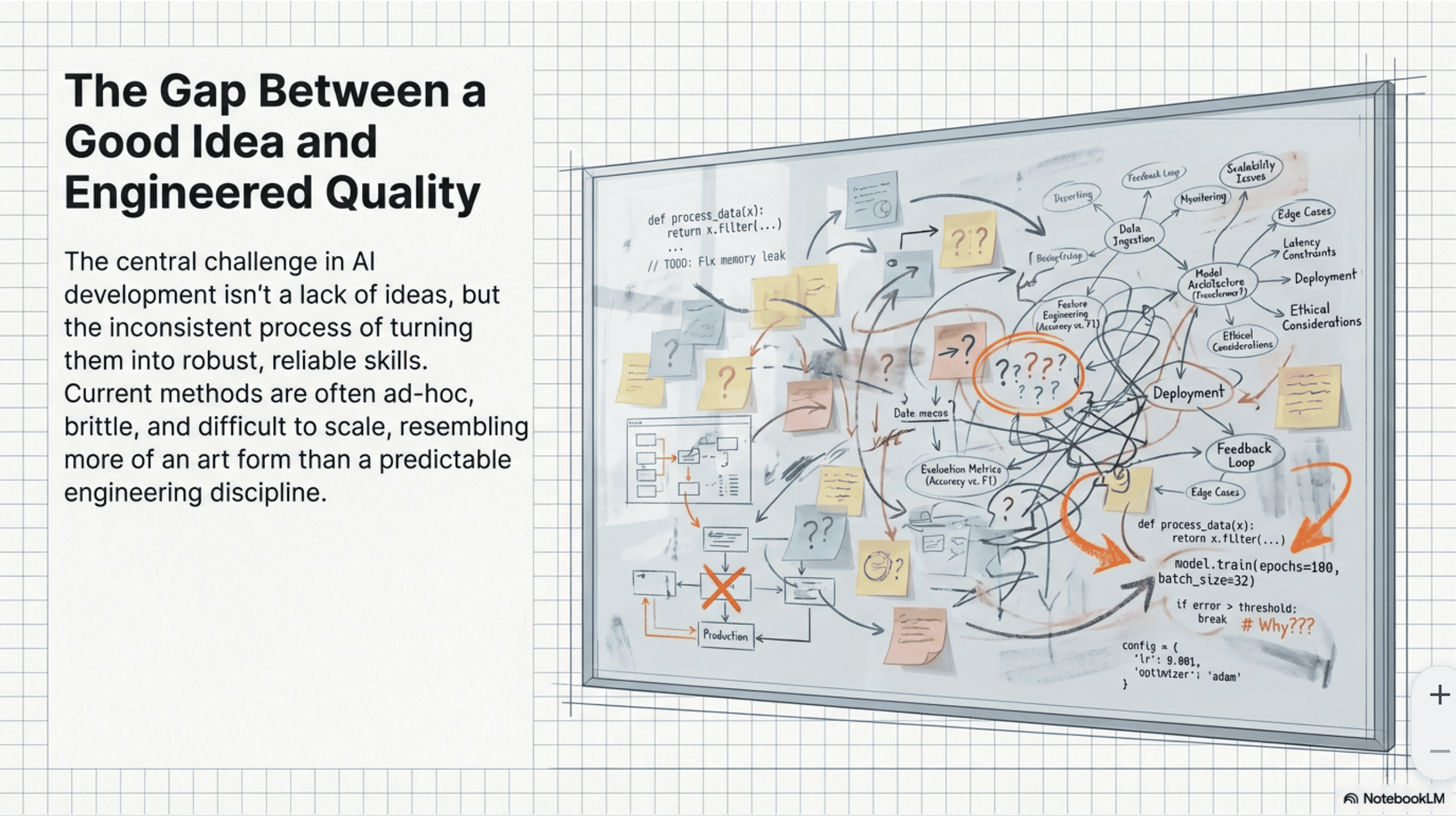
The central challenge in AI development isn't a lack of ideas, but the inconsistent process of turning them into robust, reliable skills. Current methods are often ad-hoc, brittle, and difficult to scale—resembling more of an art form than a predictable engineering discipline.
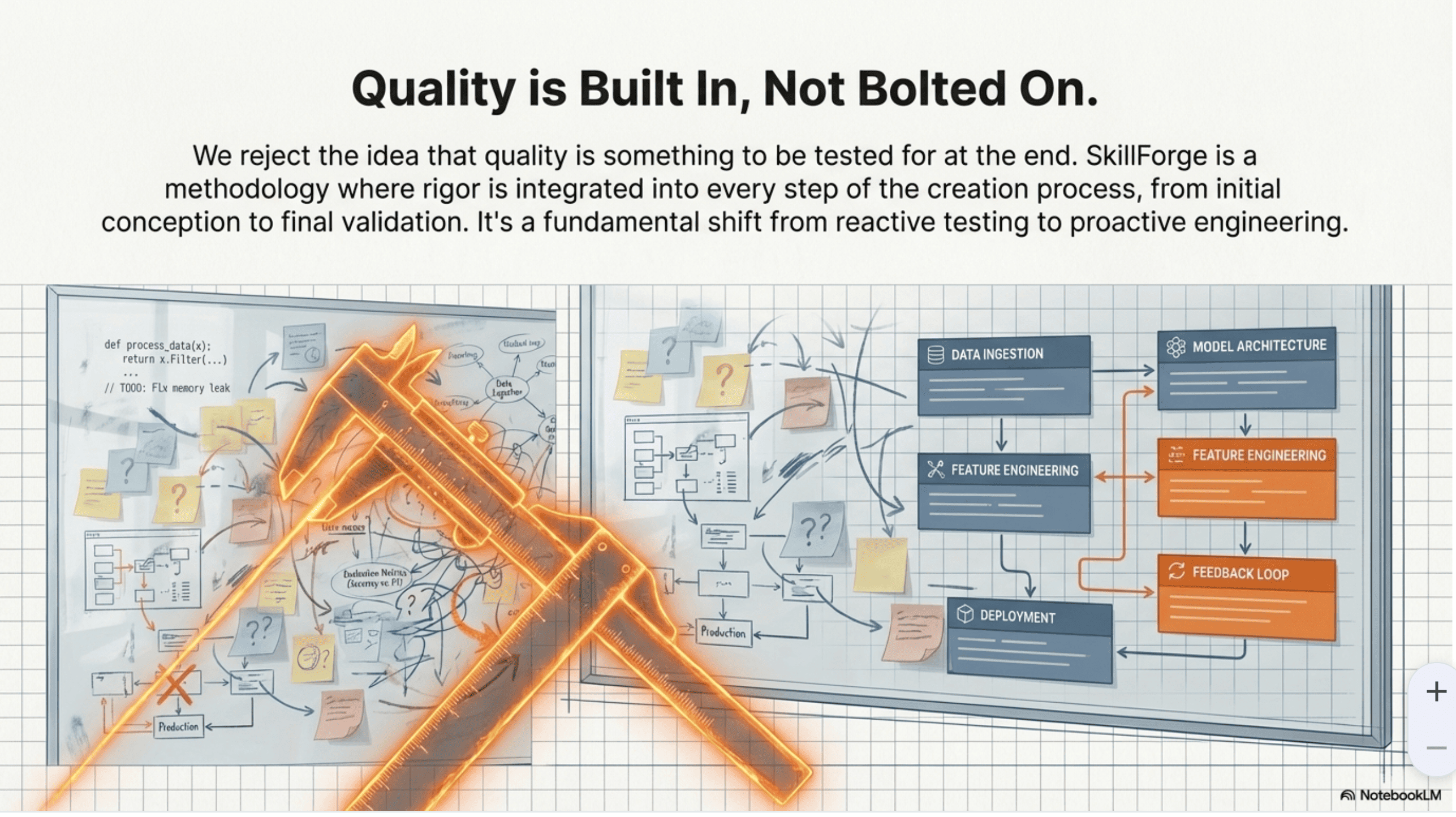
Quality is built in, not bolted on.
SkillForge is a methodology where rigor is integrated into every step of the creation process, from initial conception to final validation. It's a fundamental shift from reactive testing to proactive engineering.
SkillForge now analyzes any input—prompts, errors, code, URLs—and automatically routes to the right action:
# These all work - SkillForge routes automatically:

SkillForge: create a skill for automated code review
→ Creates new skill (Phase 1-4)

help me debug this TypeError
→ Recommends debugging skills

do I have a skill for Excel?
→ Searches and recommends matching skills
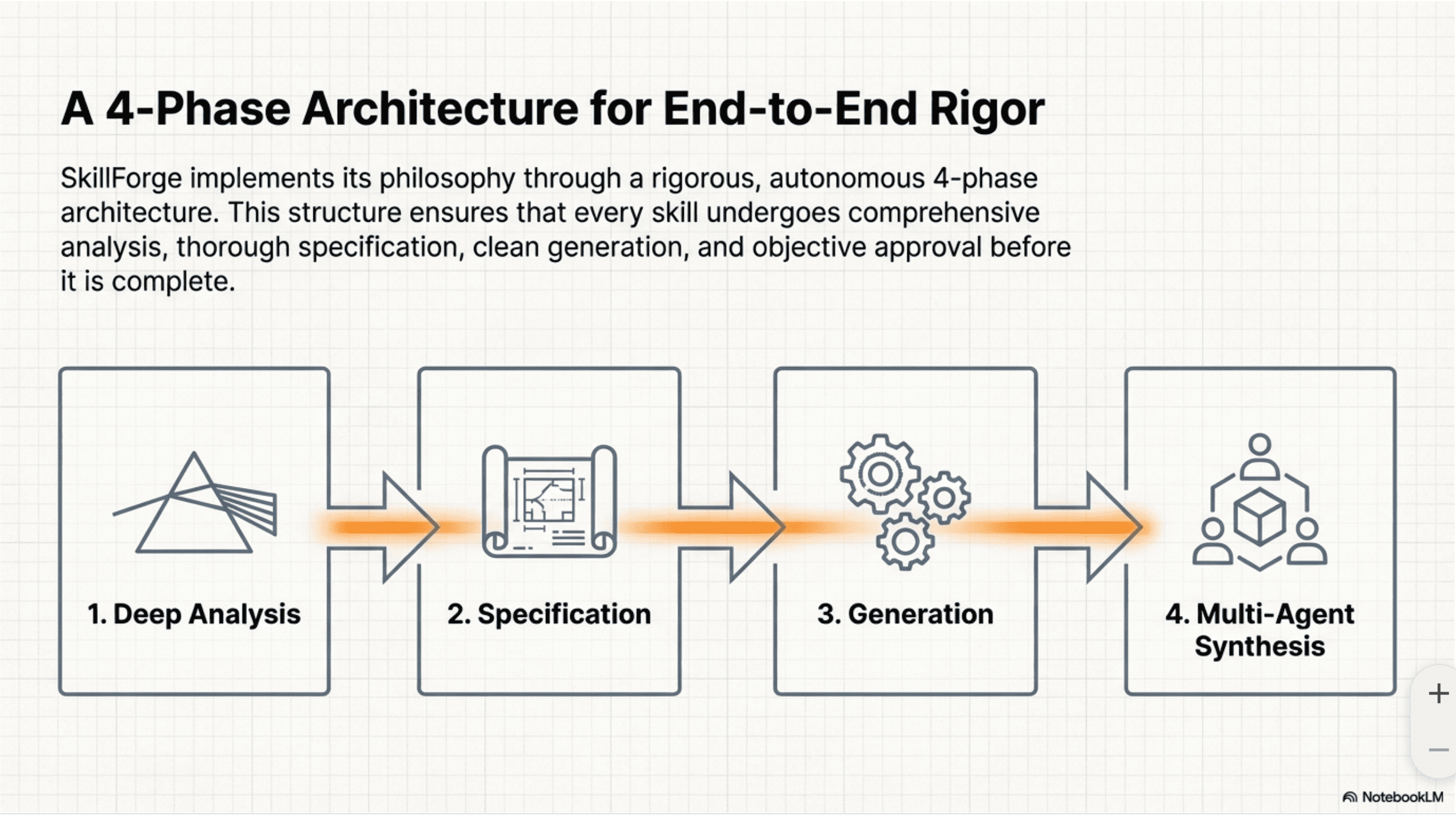
CREATE_NEW when no skills matchSkillForge implements its philosophy through a rigorous, autonomous 4-phase architecture. This structure ensures that every skill undergoes comprehensive analysis, thorough specification, clean generation, and objective approval before it is complete.
Maximum depth before a single line is generated.
Every problem is systematically deconstructed through 11 distinct thinking lenses. This framework forces a holistic and unbiased evaluation, moving beyond surface-level requirements to uncover hidden constraints, edge cases, and long-term implications.
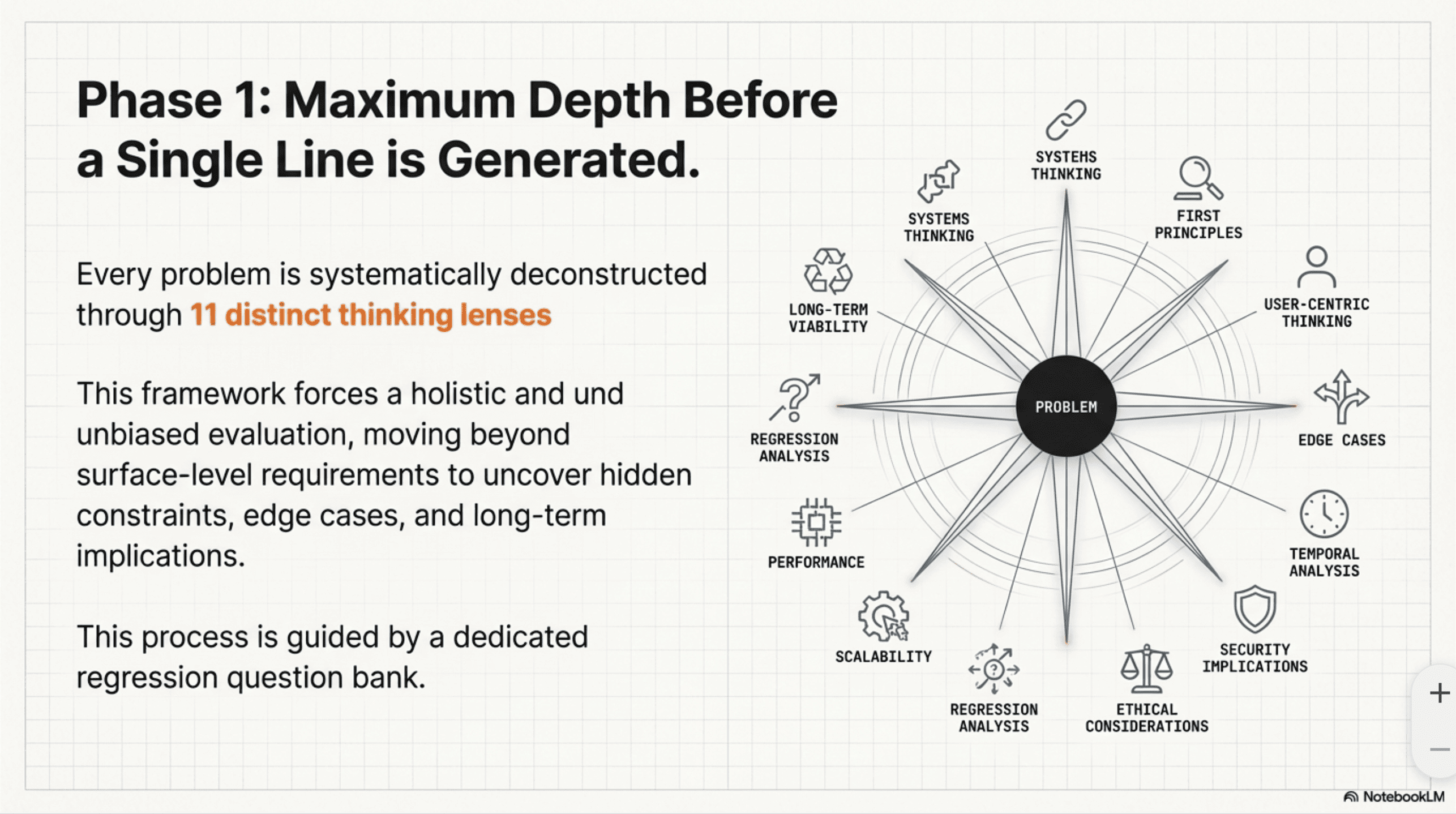
The 11 lenses include: Systems Thinking, First Principles, User-Centric Thinking, Edge Cases, Temporal Analysis, Security Implications, Ethical Considerations, Regression Analysis, Scalability, Performance, and Long-Term Viability.
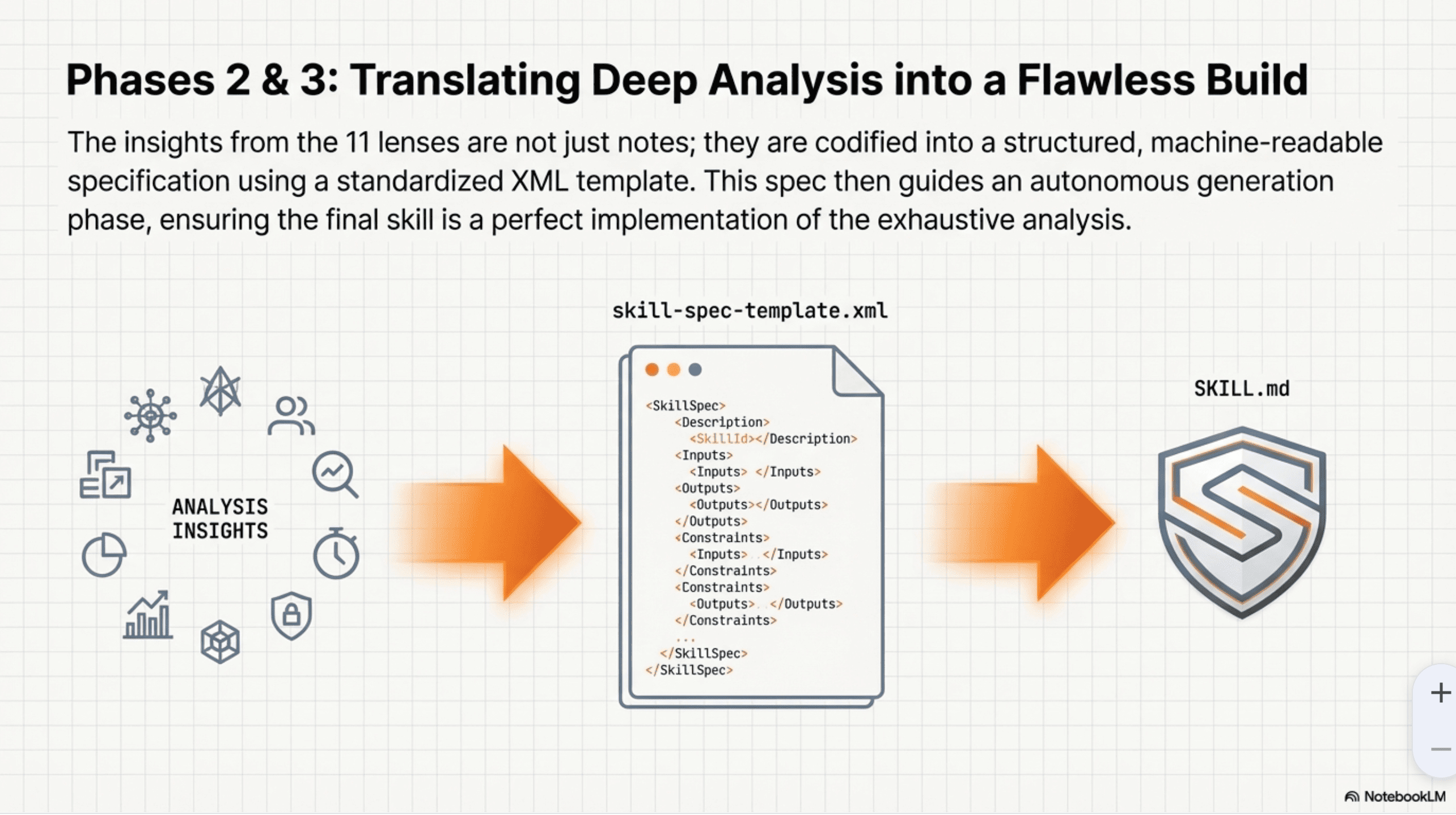
Translating deep analysis into a flawless build.
The insights from the 11 lenses are codified into a structured, machine-readable specification using a standardized XML template. This spec then guides an autonomous generation phase, ensuring the final skill is a perfect implementation of the exhaustive analysis.
A panel of experts demands unanimous approval.
A generated skill is not considered complete until it passes a rigorous synthesis protocol. It is submitted to a panel of specialized Opus 4.5 agents, each evaluating the skill against distinct, specialized criteria. Approval must be unanimous.
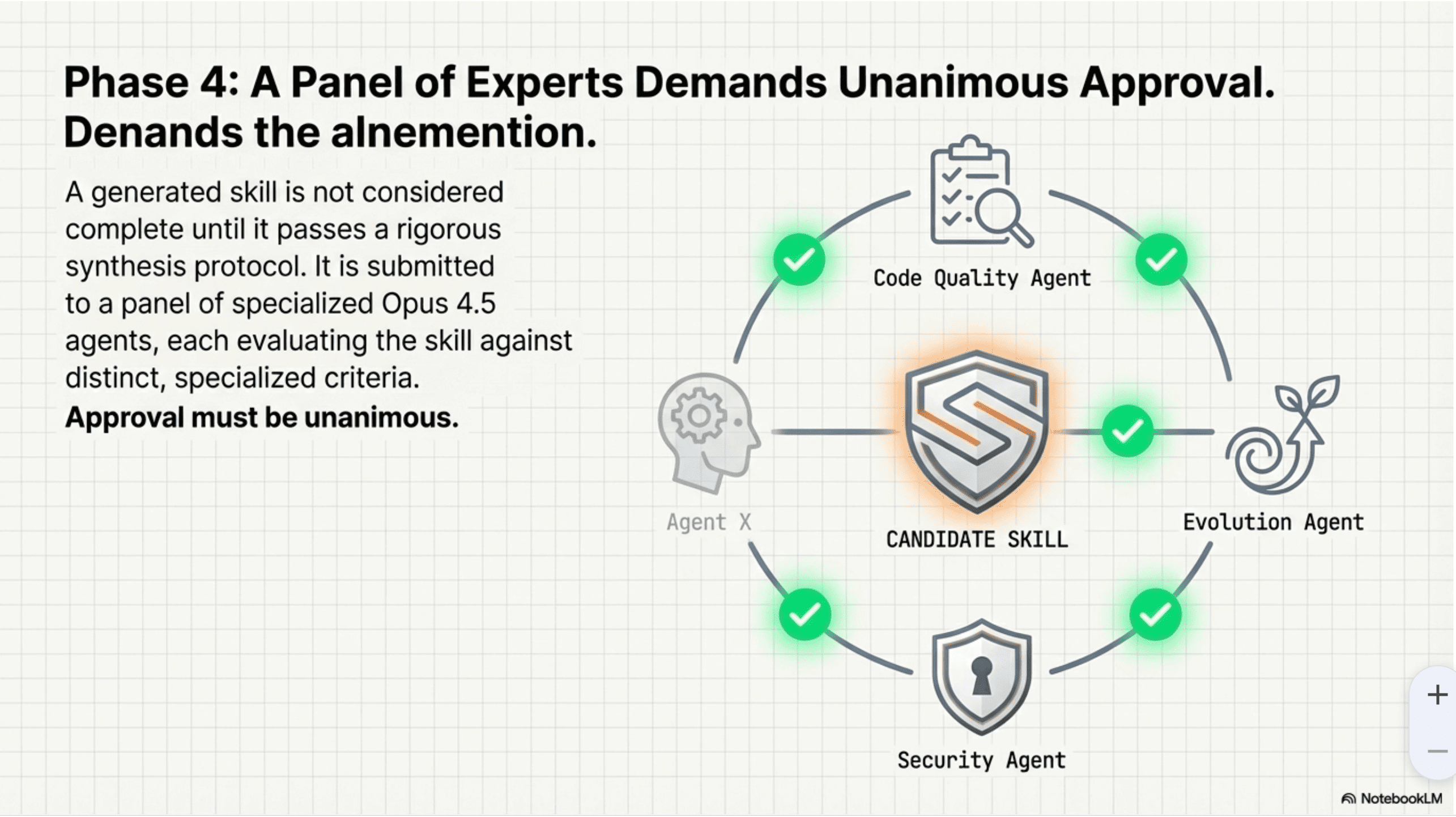
The panel includes:
- Code Quality Agent - Architecture, patterns, correctness
- Evolution Agent - Timelessness, extensibility, future-readiness
- Security Agent - Vulnerability assessment, safe patterns
- Script Agent (conditional) - Validates code quality when scripts are present
Designing for a multi-year lifespan.
Skills built with SkillForge are not ephemeral. A dedicated Evolution & Timelessness Agent scores every skill on its potential for longevity, extensibility, and future-readiness.
The skill must achieve a score of ≥7/10 to pass. This is a non-negotiable quality gate.
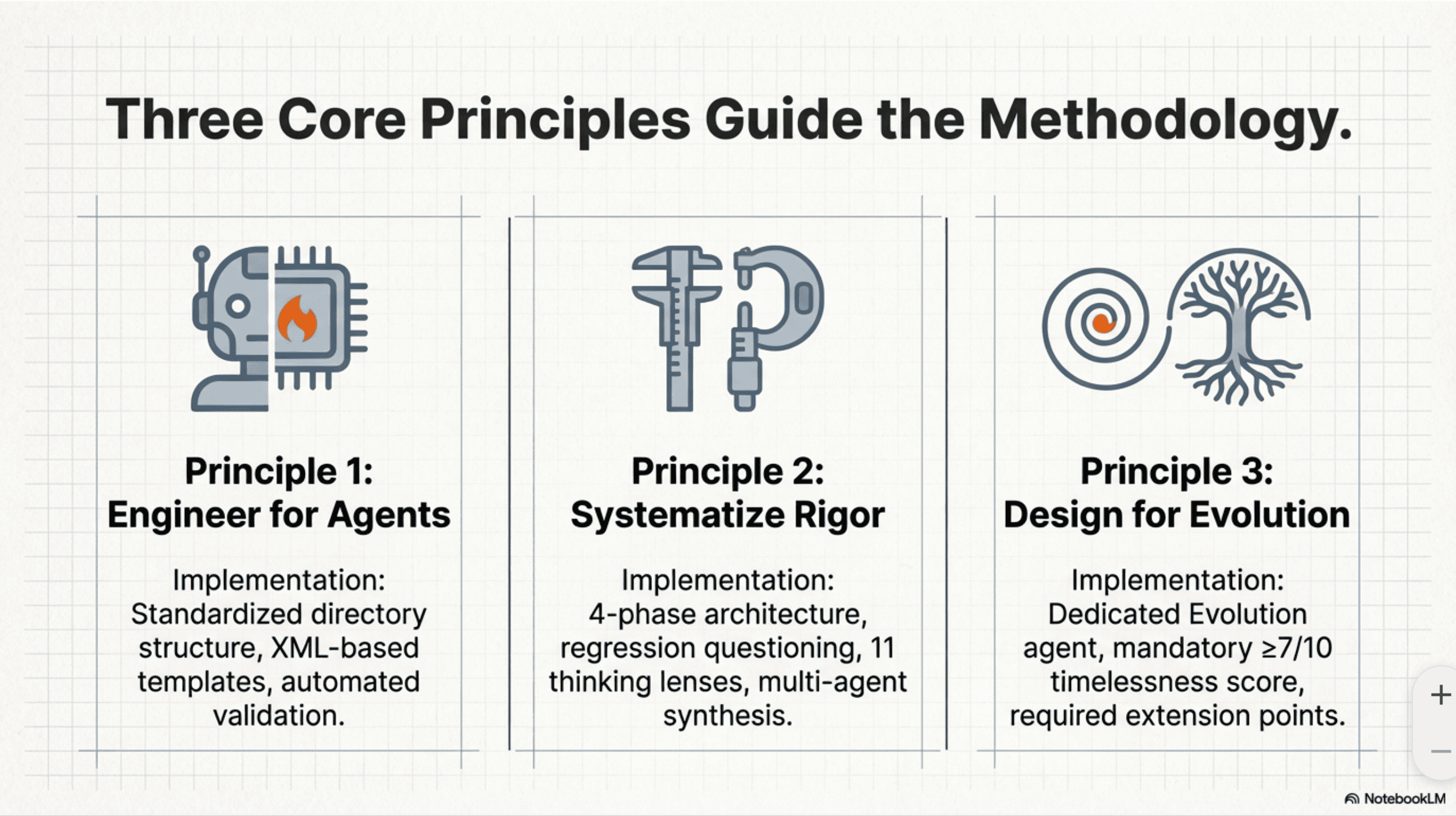
| Principle | Implementation |
|---|---|
| Engineer for Agents | Standardized directory structure, XML-based templates, automated validation |
| Systematize Rigor | 4-phase architecture, regression questioning, 11 thinking lenses, multi-agent synthesis |
| Design for Evolution | Dedicated Evolution agent, mandatory ≥7/10 timelessness score, required extension points |
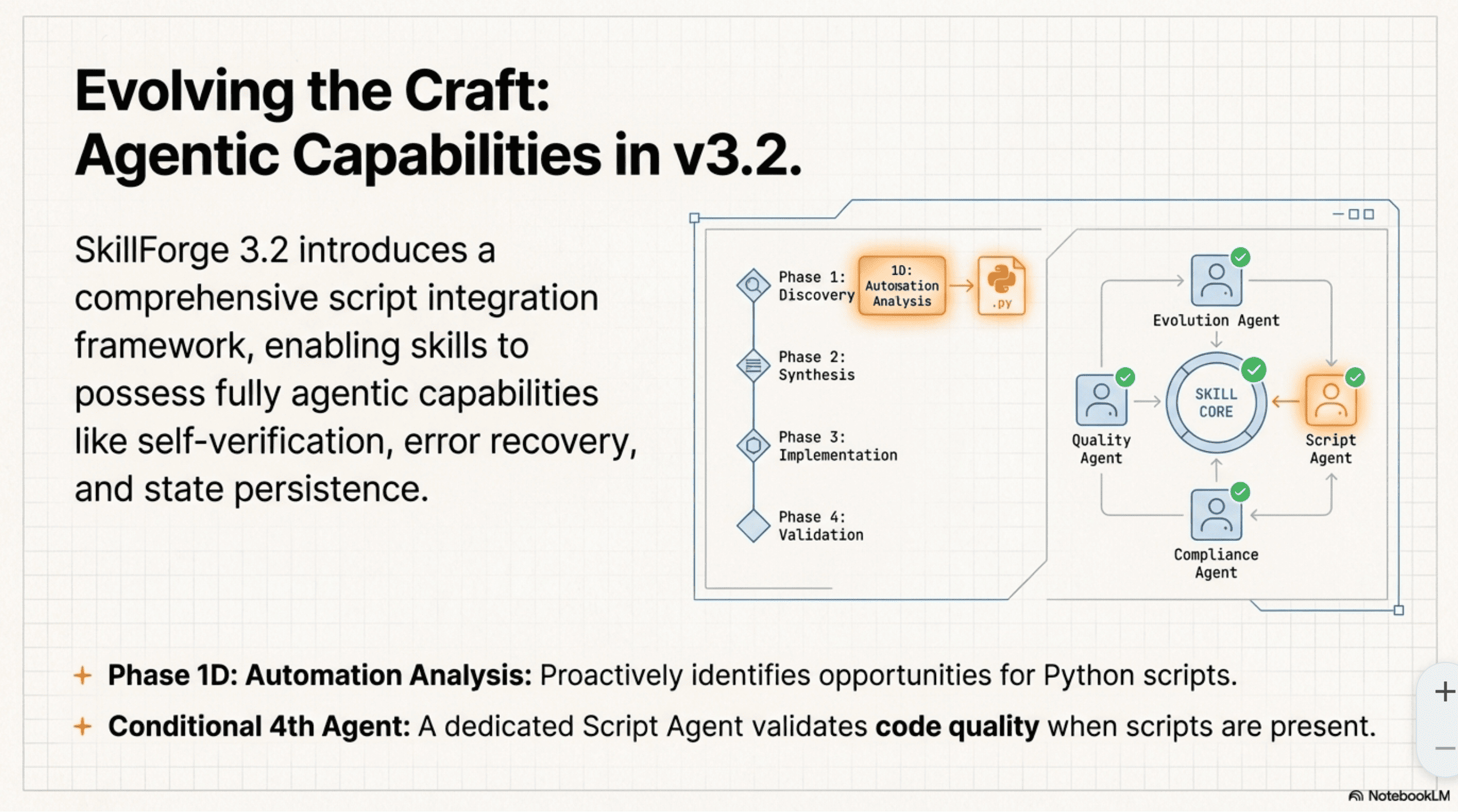
SkillForge includes a comprehensive script integration framework, enabling skills to possess fully agentic capabilities like self-verification, error recovery, and state persistence.
Key Features:
- Phase 1D: Automation Analysis - Proactively identifies opportunities for Python scripts
- Conditional 4th Agent - Script Agent validates code quality when scripts are present
- Self-verification - Scripts can verify their own outputs
- State persistence - Track progress across sessions
| Script | Purpose |
|---|---|
triage_skill_request.py |
Intelligent input classification and skill matching |
discover_skills.py |
Scans all skill sources and builds searchable index |
match_skills.py |
Multi-factor confidence scoring |
verify_recommendation.py |
Self-verification of recommendation quality |
The methodology is reflected in a clean, predictable, and standardized directory structure. Every component has its place, from templates and references to validation scripts.
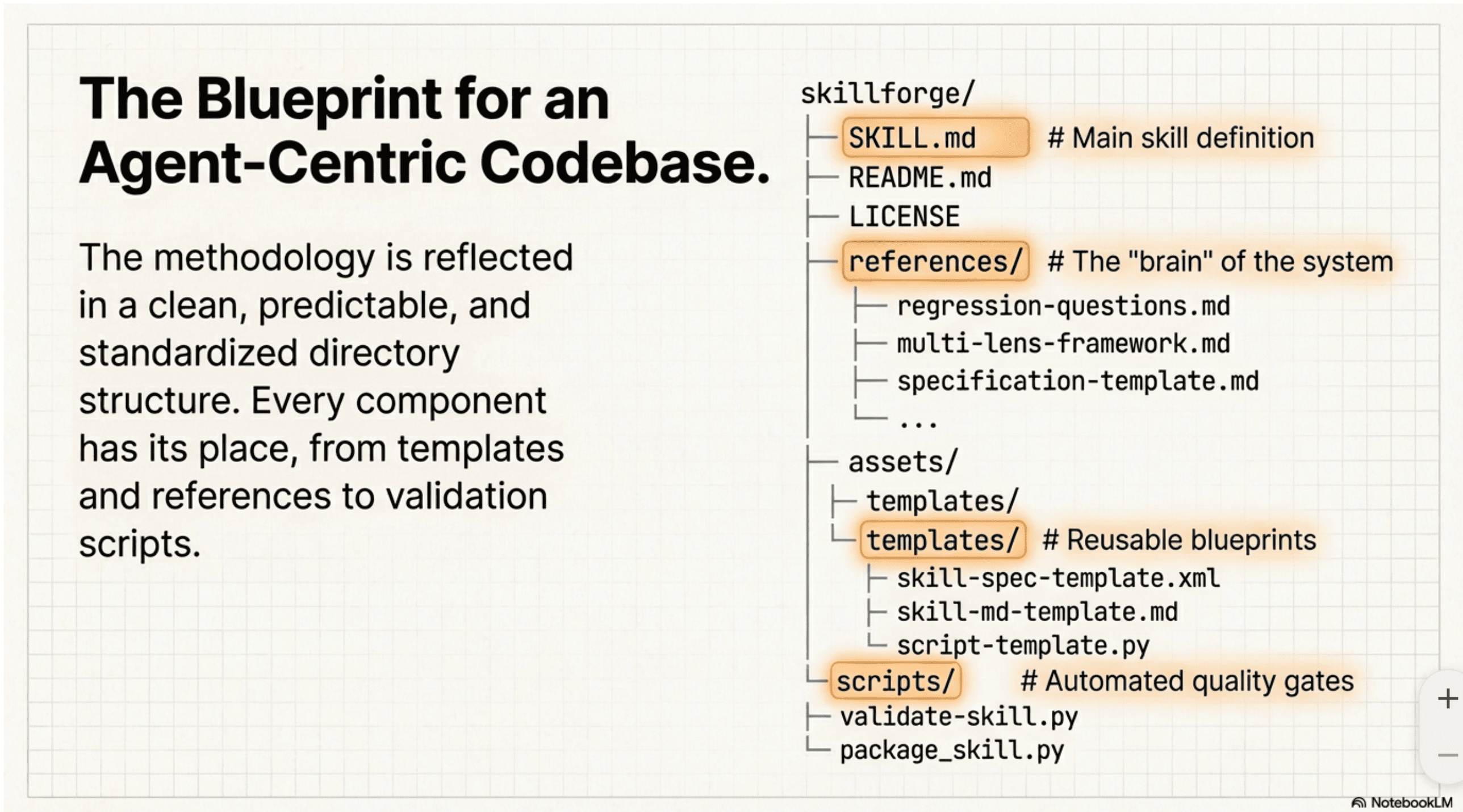
skillforge/
├── SKILL.md                    # Main skill definition
├── README.md                   # This file
├── LICENSE                     # MIT License
├── references/                 # The "brain" of the system
│   ├── regression-questions.md
│   ├── multi-lens-framework.md
│   ├── specification-template.md
│   ├── evolution-scoring.md
│   ├── synthesis-protocol.md
│   └── script-integration-framework.md
├── assets/
│   └── templates/              # Reusable blueprints
│       ├── skill-spec-template.xml
│       ├── skill-md-template.md
│       └── script-template.py
└── scripts/                    # Automated quality gates
    ├── triage_skill_request.py
    ├── discover_skills.py
    ├── match_skills.py
    ├── verify_recommendation.py
    ├── validate-skill.py
    └── package_skill.py
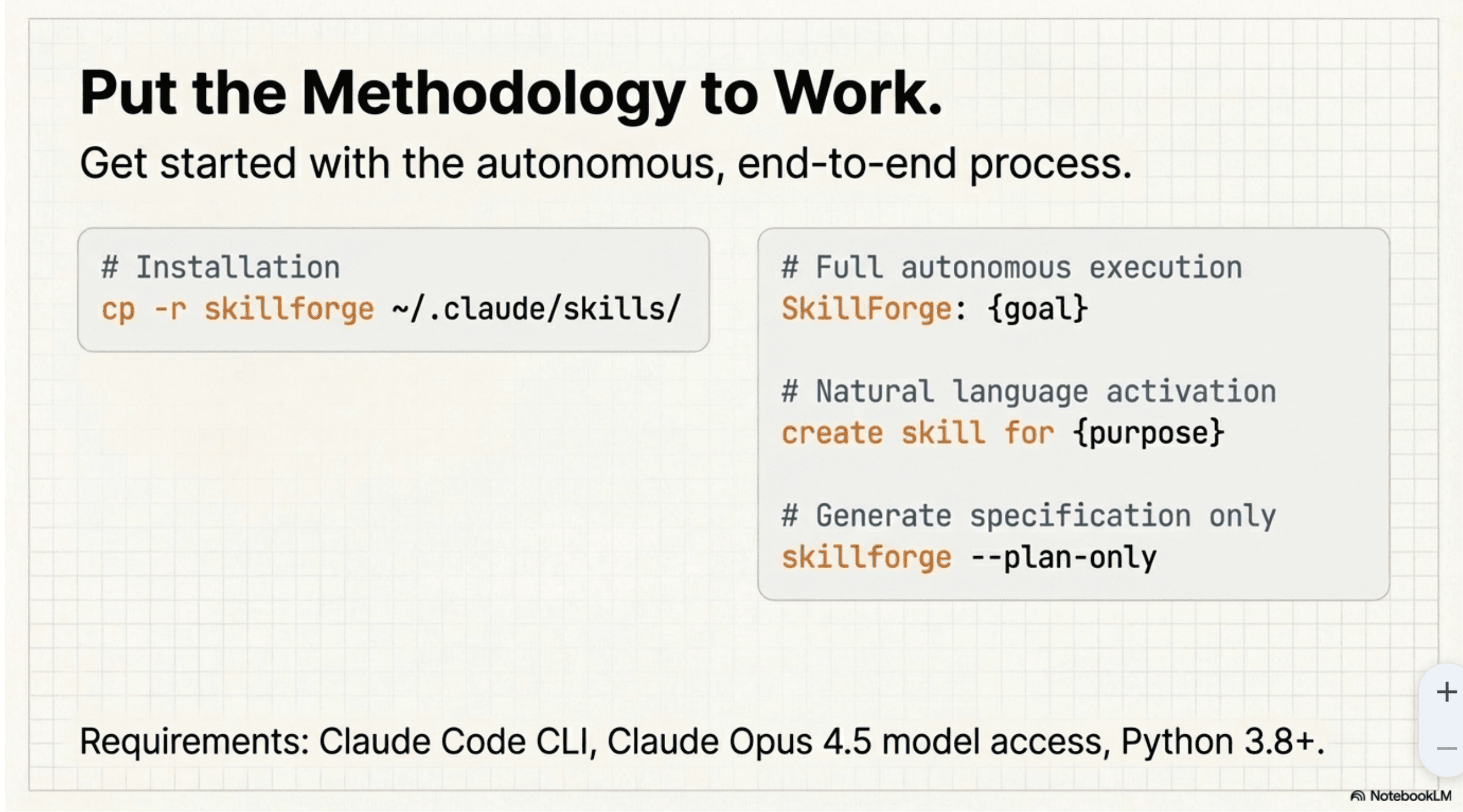
# Installation
cp -r skillforge ~/.claude/skills/

# Full autonomous execution
SkillForge: {goal}

# Natural language activation
create skill for {purpose}

# Generate specification only
skillforge --plan-only
Creation:
- SkillForge: {goal} - Full autonomous skill creation
- create skill - Natural language activation
- design skill for {purpose} - Purpose-first creation
Routing (v4.0):
- {any input} - Analyzes and routes automatically
- do I have a skill for - Searches existing skills
- which skill / what skill - Recommends matching skills
- improve {skill-name} skill - Enters improvement mode
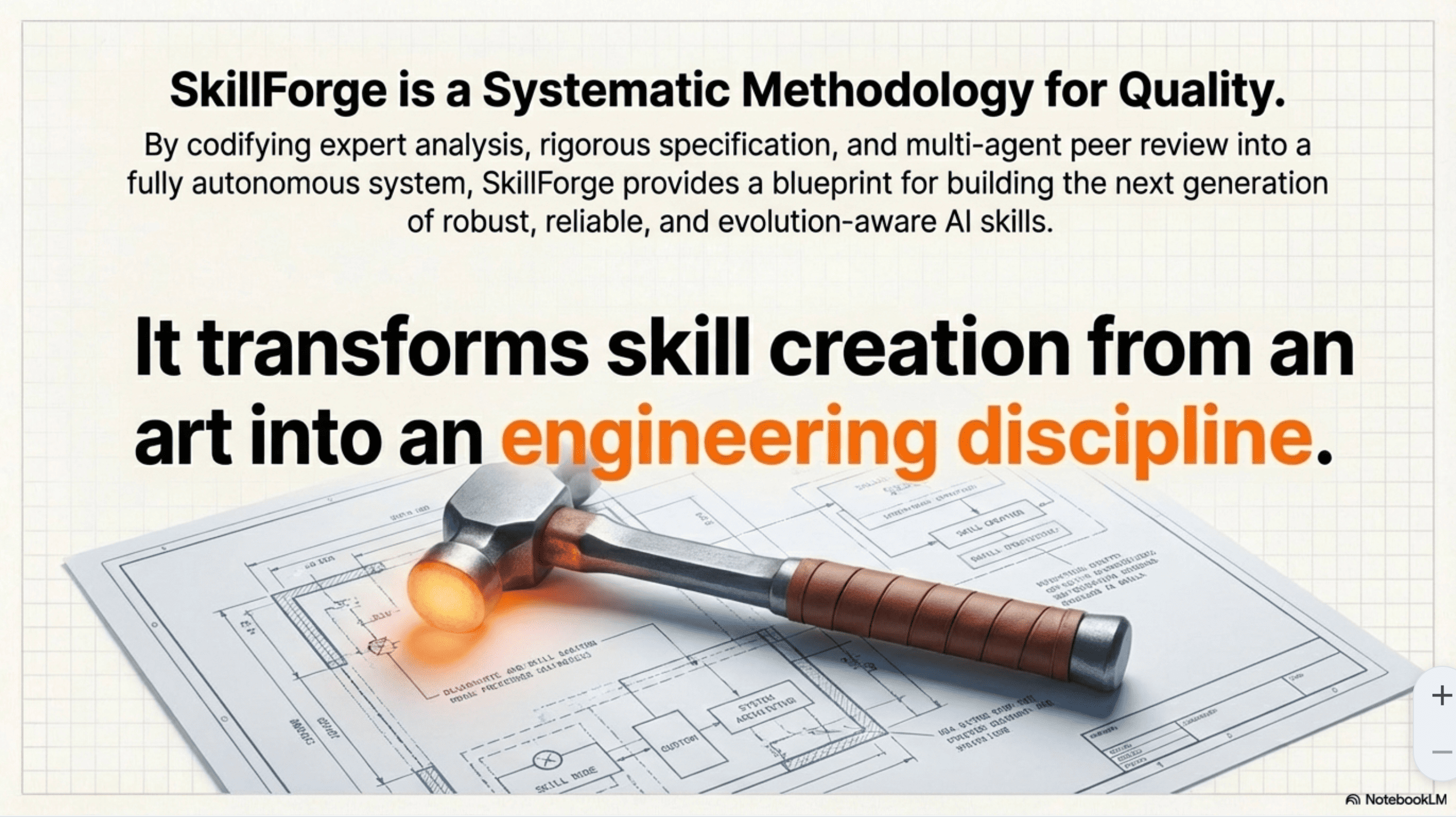
SkillForge is a systematic methodology for quality.
By codifying expert analysis, rigorous specification, and multi-agent peer review into a fully autonomous system, SkillForge provides a blueprint for building the next generation of robust, reliable, and evolution-aware AI skills.
It transforms skill creation from an art into an engineering discipline.
MIT License - see LICENSE
Refactor high-complexity React components in Dify frontend. Use when `pnpm analyze-component...
Trigger when the user requests a review of frontend files (e.g., `.tsx`, `.ts`, `.js`). Support...
Generate Vitest + React Testing Library tests for Dify frontend components, hooks, and...
Guide for implementing oRPC contract-first API patterns in Dify frontend. Triggers when creating...
This skill is compatible with the SKILL.md standard and works with all major AI coding agents:
Learn more about the SKILL.md standard and how to use these skills with your preferred AI coding agent.